
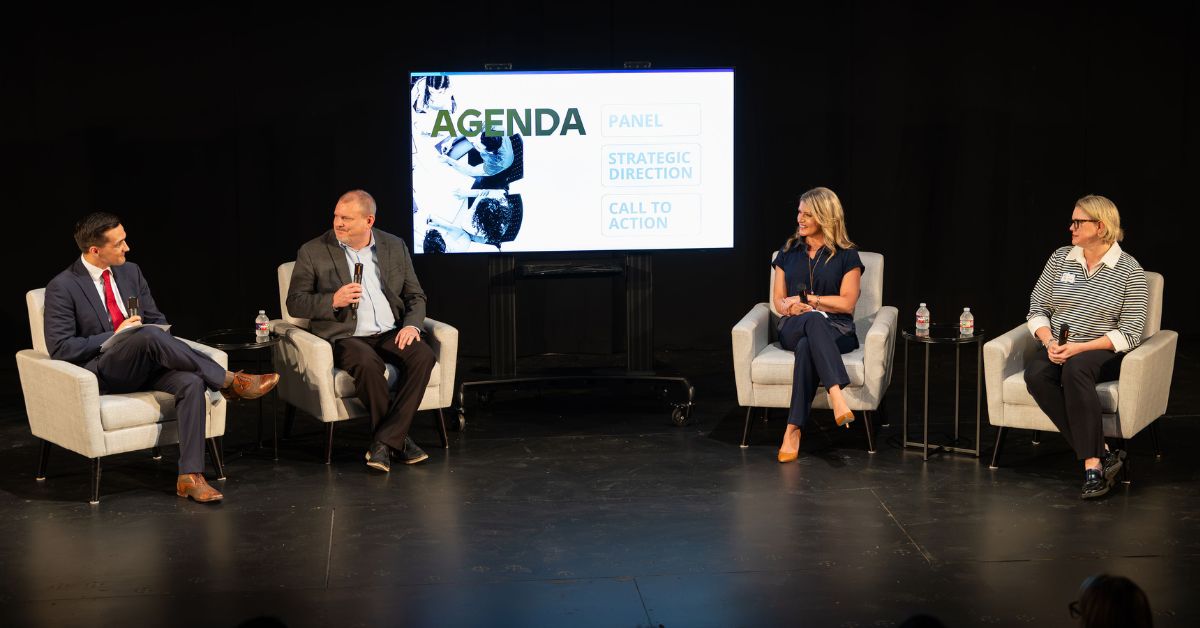
The Northwest Arkansas Council brought employers, educators and community partners together Oct. 9 at TheatreSquared in Fayetteville to outline a regional strategy for connecting education and training with career opportunities.
Executive Director David Giesige and Director of K-12 Pathways Leah Amstutz shared the proposed direction of the Council’s workforce intermediary, developed through months of conversations with regional partners.
The intermediary has three responsibilities: build the organization, unite partners around a common workforce strategy and turn that coordination into stronger pathways to high-wage, high-demand, high-quality careers.
Connecting Schools and Employers
Panelists Blythe Eggleston of the University of Arkansas, Erin Kiefer of Kiefer Sage and Jody Wiggins of the Northwest Arkansas Education Service Cooperative described a need for reliable data, sustained partnerships and opportunities to solve problems together.
Smaller businesses and districts often lack the resources to develop partnerships independently. Schools face costly equipment upgrades and competition with industry for qualified instructors. Employers can help by opening their workplaces to students and teachers and helping educators design learning around current industry needs.
Participants emphasized early career exposure, clearer information for families and preparation in communication, teamwork and problem-solving. They also identified transportation, scheduling and uncertainty about workplace learning requirements as barriers.
Giesige stressed that new programs must make effective use of the school day. One experience can help students meet graduation requirements, earn credentials or college credit and develop workplace skills while preserving options for continued education and employment.

Three Priorities for Action
Data and Shared Learning
An initial analysis by Insightful Education identified about 14,300 annual openings across 169 priority occupations. Business and management accounted for the largest share, health care showed the fastest projected growth and logistics demand included substantial replacement hiring. Ninety-five occupations had entry education requirements below a bachelor’s degree.
Annual openings reflect hiring activity, rather than unfilled jobs. Partners will expand data collection, compare talent supply with employer demand and validate findings with businesses. Common definitions, data-sharing agreements and measures of participation, completion and transitions will support a public dashboard and pathway resources on a relaunched CareersNWA website.
Employer-Informed K-12 Pathways
The intermediary proposes a shared career learning and advising framework across 16 district partners, embedded in the school day and aligned with Arkansas policy. Employers will help define professional skills and how students demonstrate them.
Partners will inventory programs, facilities and staffing to plan shared resources, including facilities or instruction, with transportation and scheduling addressed from the beginning. Employer-validated academies could combine projects, credentials, college coursework and workplace learning.
Proposed targets include at least one shared-access pathway and three academy or hands-on learning pilots by the end of 2027, advising for at least 500 students and workplace externships for 32 teachers. Partners will establish baselines and seek at least a 10% increase in regional career-connected learning participation by April 2028.
Streamlined Transitions
Employer sector partnerships will validate hiring needs, skills and credentials to guide education and training. The proposal calls for at least three partnerships by September 2027.
Tracking completion, job placement, retention and wages will help partners identify where learners need support. The work also includes underemployed adults, under-resourced communities and workers whose roles are changing with artificial intelligence. Partners propose developing at least three upskilling or reskilling program proposals by the end of 2027, including options for accelerated training and apprenticeships.
Turning Partnerships Into Opportunities

An advisory council will guide the work, supported by work groups organized around the three priorities and short-term task forces addressing specific barriers.
Giesige and Amstutz asked Northwest Arkansas partners to identify an asset they can share and a gap that needs a regional solution. Schools can help design pathways, employers can validate skills and offer workplace experiences and training providers can connect credentials to further education and employment.