 Northwest Arkansas improved its standing in 11 of 13 key areas that are central to long-term economic success, a new report published Thursday shows.
The Northwest Arkansas Council, which publishes the report in partnership with the University of Arkansas Center for Business and Economic Research, presented the 2025 State of the Northwest Arkansas Region report, highlighting continued economic progress alongside growing challenges in affordability and infrastructure.
Northwest Arkansas improved in areas such as job creation, household income, new business establishments and the among of money being spent on research. Its poverty and unemployment rates did creep up slightly.
The State of the Region report, which has been published since 2011, serves as an annual benchmark to measure Northwest Arkansas’ progress against peer regions that include Austin, Texas; Des Moines, Iowa; Durham-Chapel Hill, N.C.; Madison, Wisc.; Raleigh-Cary, N.C; and Provo-Orem-Lehi, Utah.
Those metropolitan areas and Northwest Arkansas are widely considered some of the best places to live in the nation, recognized for their steady economies and population growth as their willingness to invest in high-quality infrastructure, housing, health care and new quality of life amenities.
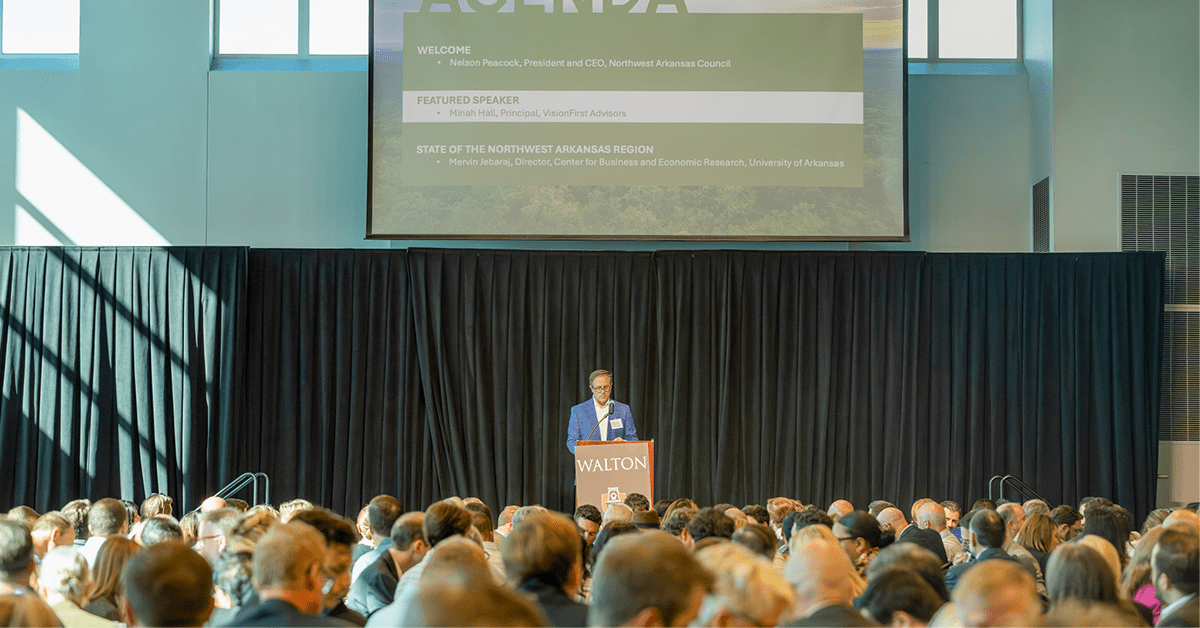
The State of the Region report was made public at a luncheon held at Town Center in Fayetteville that drew record attendance of more than 400 people.
Northwest Arkansas added nearly 7,800 net new jobs from 2023 to 2024, a 2.6% increase that tied for first among peer regions. Real gross domestic product rose 1.4% year over year, reaching $33.3 billion, while unemployment remained low at 2.7%. Median household income climbed 4.5% to $81,208, and average annual wages increased 5.3% to $59,550, marking one of the strongest five-year growth periods among comparable metros.
Nelson Peacock, president and CEO of the Northwest Arkansas Council, said the data reflects an economy that continues to gain strength and evolve in meaningful ways. “We’re seeing steady progress across the board,” Peacock said. “Employment continues to grow faster than state and national averages, household income is rising, and the region is showing real momentum in research and innovation. Together, these trends show that Northwest Arkansas is an economy in transition and trending in the right direction.”
Nationally, the economy has slowed. Mervin Jebaraj, director of the Center for Business and Economic Research, said its growth is now supported mainly by two narrow legs of consumer spending and business investment in data centers and artificial intelligence, creating a fragile base for continued expansion. In contrast, Northwest Arkansas continues to show strength across multiple sectors, with steady job creation, income growth and an expanding innovation economy.
Still, the region’s growth presents its own challenges. Jebaraj said that housing affordability and infrastructure capacity must keep pace with the economy’s expansion. A regional wastewater study currently underway is expected to show the need for the region to strengthen long-term planning and to consistently invest more in the wastewater systems.
Guest speaker Minah Hall, a national site-selection consultant with VisionFirst Advisors, commended Northwest Arkansas for its strong sense of regional collaboration, noting that teamwork across cities and counties is uncommon in many parts of the country.
Hall said perception plays a critical role in how companies decide where to invest. “Most people don’t know where Arkansas is on the map,” she said. “Part of what we need to do is just boast about ourselves better.”
The discussion by Hall highlighted the need for regional leaders to keep building the area’s visibility and momentum. In recent years, the Northwest Arkansas Council has advanced that effort through its Life Works Here campaign, which aims to elevate the region’s profile and help more people recognize it as a place of opportunity and collaboration.
Hall also highlighted the proposed Northwest Arkansas Industrial Development Authority as a promising opportunity to strengthen the region’s visibility and competitiveness. “I think it is a very important, critical step in making sure that you become a player,” she said. “If you don’t have that type of opportunity, it just shows that you don’t play well together. And I think that’s a great show of how well regionalism works. … When it’s genuine, you can read the room and see that you’re truly better together.”
Read the full 2025 State of the Northwest Arkansas Region report here.