
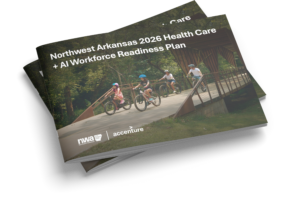
 Today, Northwest Arkansas Council and Accenture are announcing the release of the Northwest Arkansas 2026 Health Care + AI Workforce Readiness Plan, prepared by Accenture, which reflects regional employment data, stakeholder input and offers a strategic roadmap designed to prepare Northwest Arkansas’ health care workforce for the evolving role of AI.
According to the study, artificial intelligence is more likely to augment local health care roles than replace them, offering an opportunity to strengthen the region’s workforce and expand care capacity.
Health care employment in Northwest Arkansas has grown 41.8% over the past decade, adding more than 10,000 jobs and reaching more than 35,000 professionals. Projections estimate more than 7,400 additional jobs over the next 10 years, reinforcing the importance of workforce readiness as demand for care continues to rise.
“This report provides clarity about how AI is reshaping health care roles across Northwest Arkansas,” said Stefanie Pawluk, executive director of the Council’s Health Care Transformation Division. “Our responsibility is to ensure the workforce is prepared. That means equipping current and future providers with the skills and confidence to work alongside these technologies.”
The analysis finds that approximately 39% of time spent in health care roles is expected to be affected by AI through automation or augmentation. Automation exposure is highest in administrative and non-clinical roles, while clinical and allied health roles are far more likely to be augmented. In practice, that means AI will support decision-making and documentation, allowing providers to operate at the top of their training and focus more time on patients.
“AI should not be viewed as something to fear, but as a powerful enabler,” said Czar Soriano, Accenture. “This roadmap is about meeting people where they are today and helping them evolve with AI—so technology augments human expertise, strengthens care delivery, and creates sustainable career pathways for the local health care workforce.”
Regional stakeholders also emphasized the need for foundational AI literacy, hands-on training and clear governance frameworks to ensure responsible adoption across providers and education partners.
“Artificial intelligence is already helping health systems streamline documentation, improve diagnostics and better coordinate care,” said Sonal Bhakta, MD, MPH, chief medical officer, Mercy Northwest Arkansas. “The key is thoughtful implementation. When deployed responsibly, these tools can reduce administrative burden and allow clinicians to focus more time on patients.”
“AI is rapidly reshaping care delivery across Northwest Arkansas, and our responsibility is clear,” said Tina Maddox, Ph.D., associate provost of the UAMS Northwest Regional Campus. “We must prepare the next generation of health professionals to use these tools with skill and confidence. When clinicians are trained to work alongside AI, they gain valuable time with patients, strengthen care coordination, and deliver safer, more personalized care. Preparing our workforce today ensures better outcomes for our communities tomorrow, and for all patients.”
These findings build on the Northwest Arkansas Council’s Vision 2030 health care strategy, which emphasizes expanding graduate medical education, strengthening talent pipelines and improving access to specialty care. The Health Care Transformation Division will convene regional partners and advance workforce readiness, education and responsible adoption as AI continues to evolve.